5 WildApricot Alternatives to Power Your Association
One key to maintaining a thriving association is effective member management.…
July 6, 2026
Education has always been one of the strongest reasons professionals join associations. Yet many organizations struggle to turn learning into ongoing member engagement. Courses are completed, certificates are earned, but participation often ends there. Modern associations increasingly need learning experiences that connect members, not simply content libraries that deliver courses.
A Learning Management Software (LMS) is a software that organizations use to create, distribute, manage, and store educational materials and courses. It is an essential tool for supporting the professional development of organization members and centralizing institutional knowledge.
In this article, we will go over why an LMS is important, the ideal features of an LMS, why traditional LMS might not work for modern associations, and how you can choose the best one for your organization.
The main purpose of associations is to advance industries and support professionals, and education is one of the most powerful ways they fulfill this mission. Members join associations in order to gain access to industry and trade expertise, certifications, education credits, best practices, peer knowledge exchange, and expert insights.
When associations invest in high‑quality learning programs, they deliver value that improves both the member experience and organizational sustainability. Education programs help associations:
For many associations, education is more than a member benefit, it is also a significant driver of non-dues revenue through certifications, continuing education, sponsored learning initiatives, and professional development programs. As these offerings become more central to an association’s strategy, the learning management system evolves from a simple course delivery tool into a critical part of the organization’s technology infrastructure. However, delivering courses is only part of the equation. The greatest impact comes when learning is embedded in the engagement loop such as community discussions, events, networking resource libraries, and ongoing peer collaboration, creating an experience that keeps members engaged beyond course completion.
Many LMS for associations were originally built for corporate compliance training rather than professional communities. As a result, they often fail to deliver the engagement and value that modern associations need. Below are some shortcomings that traditional AMS have.
You will often find that members log into a traditional LMS, complete a single course, and never return. Without ongoing incentives or interactive content, your learning platform quickly feels purely transactional. This lack of repeat traffic prevents the system from becoming a true educational hub for your organization.
When your platform lacks peer interaction or discussion features, learning becomes an isolated chore instead of an ongoing experience. Your association consequently misses out on the opportunity to build a sustainable, loyal community around your content. Over time, this drop in engagement directly diminishes the long-term value of your member benefits.
Standalone LMS platforms tend to treat your educational courses as isolated content products rather than interconnected journeys. Your members are forced to consume information in a vacuum without any clear context for real-world application. This structure ultimately restricts the overall impact and growth of your curriculum. This results in a number of unfavorable outcomes:
A traditional LMS is often only usable for managing courses, requiring staff to manage a separate community platform for discussions and distinct webinar software for events. This scattered approach complicates your administrative workflows and drives up technology costs.
A fragmented tech stack ultimately creates a confusing, frustrating user experience for your members, as they constantly jump between entirely different systems just to learn, connect, and collaborate with their peers. This unnecessary friction often leads to lower adoption rates and decreased member satisfaction.
Traditional LMS were designed to deliver content. Modern associations need platforms that sustain participation. Your members typically derive the greatest value from spontaneous peer conversations, expert discussions, and collaborative case studies, and networking. When your platform does not accommodate these informal channels, valuable industry knowledge can get lost.
By failing to facilitate organic collaboration, rigid LMS systems can weaken one of the most valuable aspects of your association membership. To combat this, you should seek a solution that seamlessly bridges the gap between structured education and community interaction.
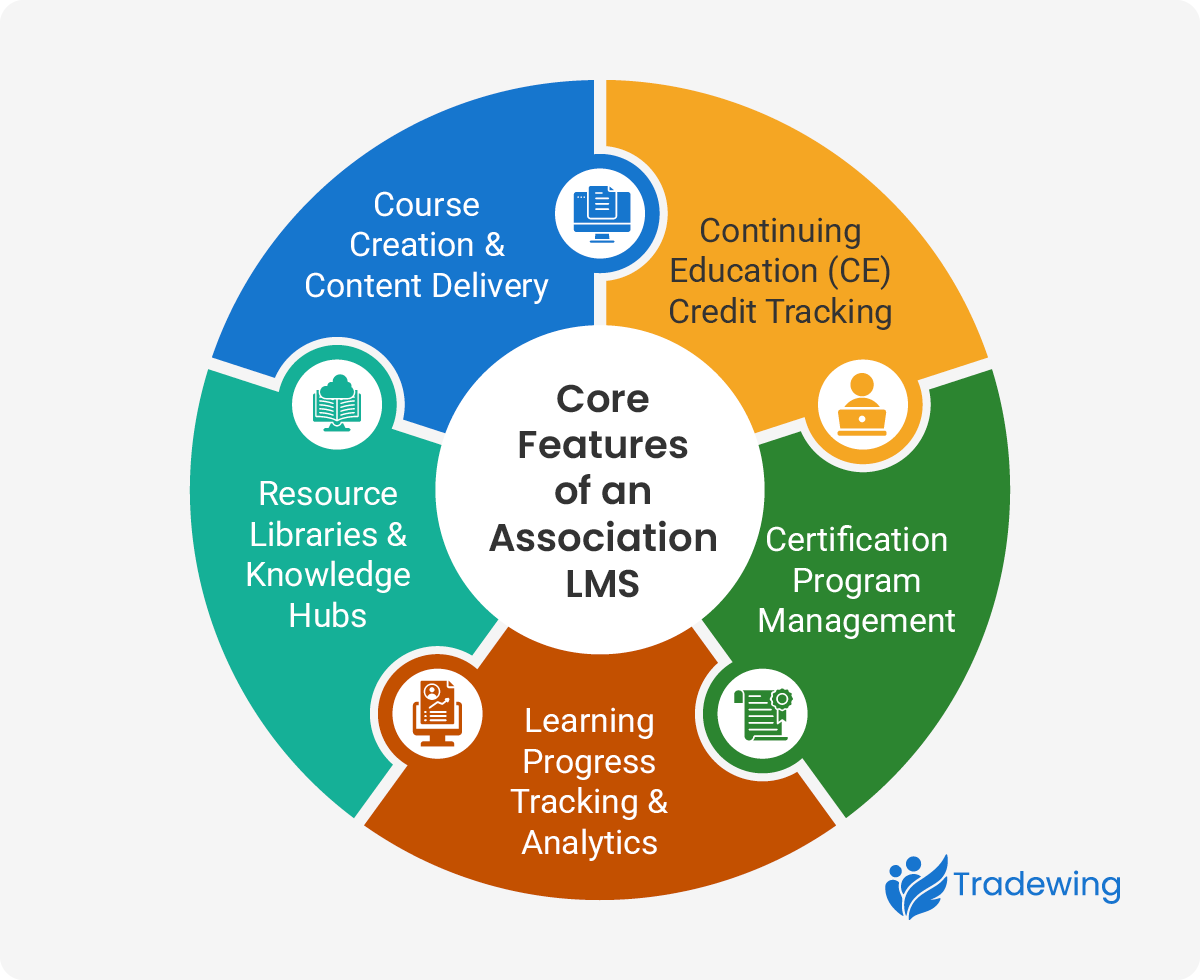
Associations increasingly need an LMS that cover all aspects of continuing education to ensure your members have a smooth professional development experience. Below are the essential features that an Association LMS should have.
Organizations frequently struggle to engage diverse learners who have different educational needs, schedules, and learning styles, making it difficult to deliver content effectively across various training models. Associations need a highly flexible, multi-faceted learning experience that maximizes reach and engagement by accommodating both self-paced and instructor-led schedules. This can be addressed through an LMS that supports mutiple modes such as video lessons, interactive modules, embedded quizzes, and downloadable resources, along with diverse distribution channels like on-demand libraries, certification pathways, and cohort-based training.
Manually tracking course completions, calculating CE credits, and monitoring regulatory deadlines creates a huge administrative load for staff while putting learners at risk of accidental compliance lapses. The goal is to eliminate manual tracking errors, reduce operational workloads, and provide learners with a real-time, transparent view of their progress to ensure they stay active and compliant. This process is fully automated through compliance and renewal engines within the LMS that calculate credit accumulation behind the scenes and triggers alerts for license renewal deadlines.
Overseeing complex certification pathways, securing formal exam administration, and tracking long-term recertification requirements can be operationally exhausting and risks undermining an organization’s professional credibility. Organizations need a structured and secure assessment procedure that guides students from initial enrollment through major milestones. This is achieved through end-to-end certification management technology that automates tailored pathway tracking, formal exam administration, and the instant issuance of digital certificates upon successful program completion.
Without clear visibility into student engagement and completion rates, it is difficult to refine curriculum strategies or prove a clear ROI to stakeholders, board members, and sponsors. Associations need a data-driven strategy where organizations gain deep insights into which specific topics resonate with their audience, allowing for continuous, measurable improvement. This can be unlocked by AI-powered analytics and reporting dashboards that track real-time engagement trends, generate detailed progress reports, and deliver personalized content recommendations.
Valuable organizational assets, such as industry reports, research papers, and recorded webinars, frequently get buried in cluttered digital spaces, making critical industry knowledge inaccessible when members need it most. Ideally, there is a single source of truth where historical and current data are safely archived, organized, and immediately available. With a knowledge hub built directly into an engagement platform, members can use search features to instantly locate resources they might need access to.

Now that you know why an LMS is important, as well as its essential features and possible shortcomings, you have enough information to have a rough idea of what to look for in an LMS. Let’s take it a step further and walk through the practical factors you need to weigh before you finally make a decision.
Before diving into the vast market of LMS features, you must draw a hard line between your absolute “must-haves” and your “nice-to-haves.” Identifying your non-negotiables prevents you from being swayed by expensive tools that do not actually solve your core problems. This approach saves time during the vetting process and ensures you choose a platform built to handle your daily dealbreakers from day one.
Your non-negotiables will depend on your specific business model and needs, but they typically center around the features that keep your operations running legally and smoothly. You should ensure that your potential choice can fully support your baseline requirements, which often include:
You have to look beyond the initial upfront price tag to truly understand the platform’s total cost of ownership. Different software vendors use vastly different pricing structures, ranging from flat monthly rates to per-user variable fees.
Make sure you scan the fine print for hidden operational costs that can quickly break your budget. You should watch out for extra charges regarding data storage limits, implementation support, and premium integration features. Securing a transparent, predictable pricing plan ensures you can safely scale your learning ecosystem over time.
Building out a polished, functional learning platform takes time, so you need to establish a realistic launch schedule from the start. You should ask potential vendors for an honest breakdown of their typical onboarding windows so you can plan your marketing and course rollouts accordingly.
A successful implementation plan should always account for these critical phases:
Your new learning platform should never live on an isolated digital island within your organization. It is essential to choose an LMS that connects seamlessly with the critical software systems you already use every day.
When your software systems talk to each other automatically, you protect data accuracy and save your staff from tedious manual entry. You should verify that the platform integrates smoothly with your CRM, email marketing tools, and webinar software. This interconnected setup creates a fluid user experience for your members and a highly efficient workflow for your team.
Never commit to a long-term contract based solely on a sales pitch or a tempting marketing brochure. You should request a personalized demonstration where the vendor actively walks through your organization’s specific, daily use cases.
During your hands-on trial period, your team should thoroughly test the system’s ability to handle these core workflows:
With these considerations down, you can be more confident that your LMS of choice will fit perfectly with your organization.
The way associations approach learning is evolving. Rather than treating education as a standalone function, many organizations are looking for ways to connect courses, discussions, networking, events, and resource libraries into one continuous member experience. This is the approach Tradewing was built around. As a continuing education software for associations, Tradewing transforms isolated learning into an integrated experience, resulting in boosted participation, strengthened member relationships, and increased non‑dues revenue.
Tradewing solves the problems that traditional AMS platforms may pose.
| Problem (Traditional LMS) |
Tradewing Solution |
| Low Member Engagement | Tradewing integrates community discussions, events, and peer networking, turning education into an ongoing experience. |
| Isolated Learning Experiences | Tradewing unifies structured learning with peer knowledge exchange, enabling members to learn from each other and industry experts. |
| Fragmented Technology Stacks | Tradewing consolidates education, community, events, and resources into one membership learning platform, simplifying access and boosting engagement. |
| Limited Knowledge Sharing | Tradewing enables knowledge hubs where members can share insights, discuss challenges, and build professional networks alongside formal education. |
A good LMS platform won’t make the cut if members do not see value in participating actively. Giving your members a space to hang out, collaborate, and learn from each other ensures not only their professional development but also engagement and consequently, retention. With Tradewing, you can do this on a single platform.
As organizations shift toward more interactive learning ecosystems, the traditional LMS is getting outdated very quickly. By weaving your LMS into community tools, live events, and knowledge libraries into a single platform, you transform education from a transactional checkbox into an active, collaborative learning journey. This interconnected environment ensures your members are never learning in a vacuum, but are instead supported by a dynamic network that encourages ongoing growth.
Choosing an LMS is no longer simply a technology decision. It’s a decision about how learning fits into your broader member experience. Associations that connect education with community, events, and ongoing participation create more value for members, and ultimately build stronger organizations. As learning continues to evolve, the platforms that bring those experiences together will be better positioned to support long-term engagement.
Tradewing was designed specifically to streamline your operations while keeping member engagement high. Instead of forcing you to manage a fragmented tech stack, it weaves your entire learning together in one unified system. With Tradewing, you can give your members a true professional home that they actually want to be in.


Rhona is a Marketing Specialist at Tradewing, creating content and campaigns that help associations strengthen member engagement, simplify communications, and support long-term growth.

One key to maintaining a thriving association is effective member management.…
July 6, 2026
Member retention is at the heart of every successful association. In this…
July 6, 2026
For many associations, selecting an association management system is no longer just…
July 3, 2026